Museum of Bochnia Salt Mine: how Droplabs Dynamic Pricing supports a UNESCO World Heritage Site

Context
In the 14th century, when the mine became part of the Kraków Saltworks, King Casimir the Great drew on the expertise of Genoese merchants to ensure efficient extraction and maximize profits from the royal salt monopoly. It was an innovative move by the standards of its time. Today, facing the challenges of modern tourism, the managers of the Mine - a precious UNESCO World Heritage Site - are proving that they are still “not slowing down.” Instead of Italian merchants, innovation today means focusing on online ticket sales for individual visitors and implementing Droplabs Dynamic Pricing. This modern strategy is designed to boost attendance, streamline visitor flow management, and make this State Treasury-owned site more affordable. The new pricing system opens the Mine to families on tighter budgets by offering lower prices - prices the Mine could not, for economic reasons, offer under a traditional fixed price list.
Before we move on to the detailed data and results, let's hand over to the President of the Management Board of the Mine, Krzysztof Zięba. In a short video interview, he explains how the Mine increased attendance, how dynamic pricing helped eliminate queues and shift 80% of sales online, and why buying tickets earlier benefits both visitors and the site itself.
The Challenge
The Museum of Bochnia Salt Mine, as a State Treasury company, focuses on enabling as many people as possible to discover this extraordinary historical and cultural heritage.
The key operational challenges at the Museum of Bochnia Salt Mine stem directly from its status as a historic monument and its unique sightseeing format:
- Planning challenges and financial risk: Tours depart only at fixed times and must be led by a guide. Crucially, the number of places in each group is capped in advance. The challenge is to add new tours efficiently and plan guide staffing. Launching additional groups without sufficient confidence that demand will materialize carries significant logistical and financial risk. At the same time, opening additional groups well in advance boosts attendance, because it allows more visitors to “fit in” on the most popular days.
- Social mission: The Mine's priority is its social mission of making UNESCO heritage accessible, so it is important that tickets remain affordable. At the same time, rising operating costs - guide and staff salaries, maintenance of the historic site, and the drive to keep improving the visitor experience - require a steady stream of revenue.
To respond effectively to these complex challenges, the managers of the Museum of Bochnia Salt Mine made a strategic decision in the first quarter of 2025. They committed to making the online channel the dominant sales channel for individual visitors and implemented Droplabs Dynamic Pricing. They chose a partner that had already helped solve the operational challenges of prestigious sites such as Tatra National Park (TPN).
The Solution
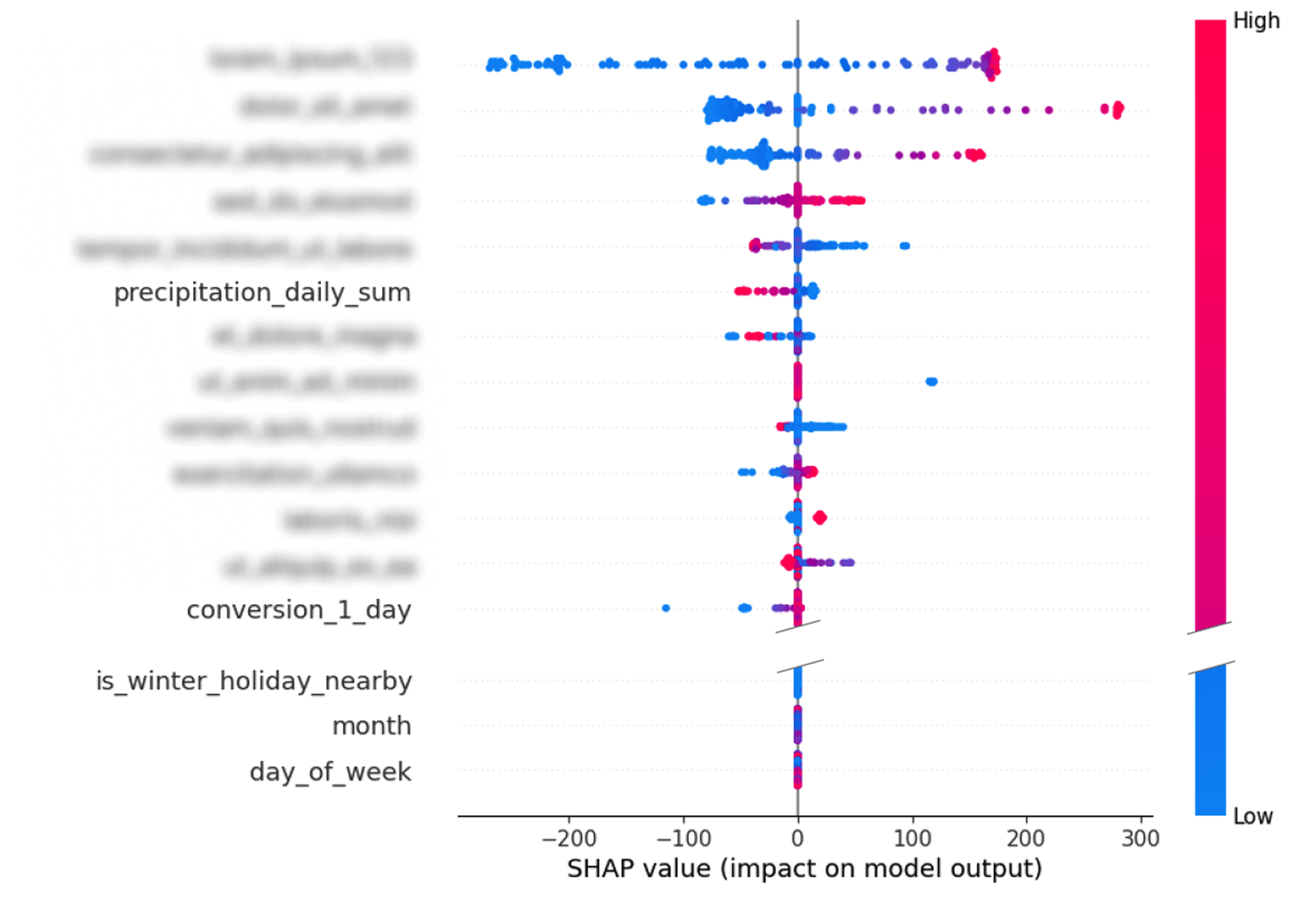
Droplabs Dynamic Pricing is based on proprietary algorithms that raise prices for selected dates in real time. These algorithms analyze a wide range of data, such as weather forecasts, current signals from the online store, and historical trends, to set the optimal price. The goal is twofold: to maintain strong interest in the offer and, at the same time, to encourage customers to buy earlier.
Before Droplabs Dynamic Pricing was introduced, the Mine's tour prices were the same online and at the box office. For example, in the low season, a guided visit to the “Tourist Route with the Underground Multimedia Exhibition” for a 2+1 family:
- before Dynamic Pricing was introduced, cost PLN 178;
- after Dynamic Pricing was introduced, cost PLN 166 online and PLN 196 at the box office.
Dynamic prices immediately broadened access to the Mine: a 2+1 family could now buy a ticket online from PLN 166, saving PLN 12 compared with the previous fixed price list. In this way, the Mine strategically combined its social mission of cultural accessibility with financial efficiency, while also increasing revenue - the details of this balance are discussed below.

The message “Buy earlier, pay less!” was displayed prominently on the Mine's homepage. This direct communication effectively steered customers to the online store, where they could immediately see the full range of prices for different visit dates.

The result?
Two out of three visitors buy their ticket at least a day before their visit! The effectiveness of the Mine's decisions in marketing, visitor management, and pricing was reflected in visitor ratings. The average Google rating during the first six months of Droplabs Dynamic Pricing reached an impressive 4.9/5! This is a significant increase from 4.6/5 in the same period the previous year, clearly confirming the excellent work of the Mine's staff, management, and board in fulfilling the site's mission.
Overall results after six months of Droplabs Dynamic Pricing
March–August 2025
Attendance
- The Mine recorded a spectacular 31% year-on-year increase in individual attendance, from 39,000 to 51,000 visitors over six months. Several key factors contributed to this success:
- Effective marketing: Successful promotional campaigns run by the Mine's in-house team.
- Efficient addition of new tours: The Mine's team responded proactively to early sell-out signals, which were more frequent than in the previous year because more visitors bought in advance. Thanks to early preparation, additional guides were scheduled and new tours were launched, allowing the Mine to serve more visitors than the year before.
- Market conditions: The impact of external factors such as weather, interest in the offer, and the competitive landscape.
- Fewer changes of plans: Dynamic Pricing increased the number of visitors buying tickets in advance, who as a result changed their plans less often. The estimated additional attendance from this effect over six months is 2,800 people, a 7% increase over the attendance that would have been achieved under the same market conditions with a traditional sales model.
- Better price affordability - tours were widely available at lower prices than a traditional sales strategy would allow.
- 66% of visitors bought their tickets at least 1 day in advance.
- 25% of visitors bought their tickets at least 4 days in advance.
Additional revenue
- At the same time, the Mine was able to earn more from less price-sensitive customers - the revenue surplus above minimum prices from the online channel alone amounted to several hundred thousand PLN over six months.
- Just under one percent of online payments is for tickets that end up unused, where the customer neither requested a refund nor changed the date - so-called “no-shows.” Over six months at the Museum of Bochnia Salt Mine, this amounted to tens of thousands of PLN in additional revenue! It is worth noting that the Mine is very visitor-friendly and does process date changes and refunds!
- Thanks to the excellent attendance and higher average revenue per visitor, the Mine generated 45% more revenue from individual visitors than in the same period the previous year.
Faster service and operational improvements
- Dominance of the online channel: As many as 80% of individual visitors bought their tickets online and went straight to the shaft elevator, where the guide scanned their tickets, bypassing the box office. Box-office sales accounted for only 20% of the total.
- Zero queues and less stress: Thanks to the high share of visitors buying in advance (the vast majority bought online), no queues formed and the atmosphere stayed calm, even on the busiest days (close to a thousand visitors per day) and despite the limited space in the hall.
- Better attendance forecasting: Advance sales data and notifications from the Droplabs panel enabled the team to forecast attendance much more accurately.
- More efficient tour management: Better predictability made it easier to add tours, maximizing the site's capacity while minimizing the economic risk of launching under-filled groups.
Marketing that drives future attendance
- Average Google rating for this period: 4.9/5 versus 4.6/5 the previous year.
- Number of Google reviews added during this period: 1,554 versus 227 in the same period the previous year (almost a sevenfold increase!).
Case in point: Tourist Route with the Underground Boat Crossing
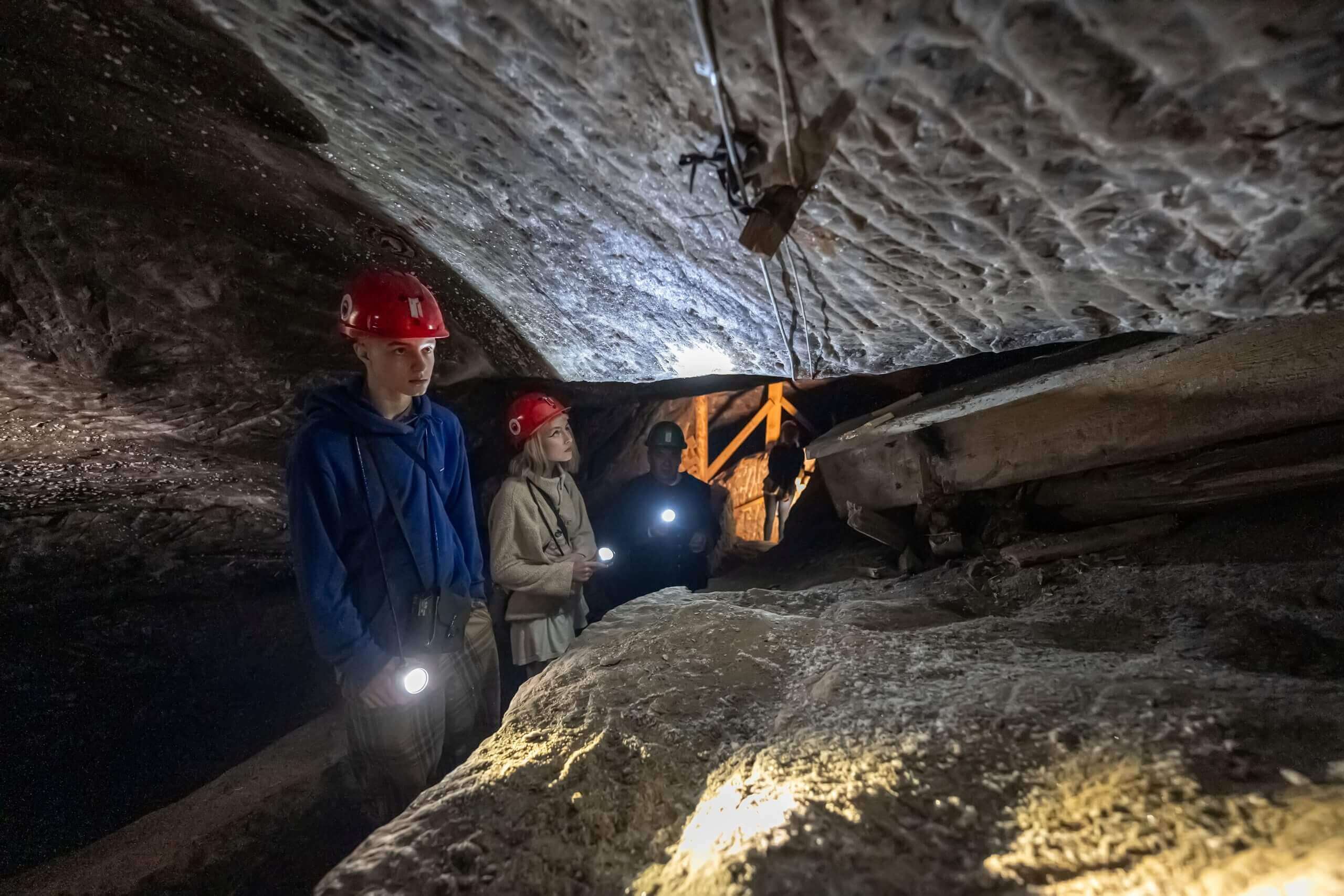
To illustrate how Droplabs Dynamic Pricing works, let's look at how the price of a standard ticket for the popular Tourist Route with the Underground Boat Crossing changed in the run-up to the May long weekend.
In mid-April, a ticket for May 1 cost PLN 103. Initially, three tours were available (one guided group per tour). Customers had a clear incentive to buy early.
The Droplabs system monitored how quickly the tours were filling up and sent signals to the Mine's team. Thanks to this information and the team's hard work, the Mine was able to respond quickly:
- New tours (time slots) were added.
- Capacity was increased for existing time slots by scheduling additional guides and adding more groups.
Impact on price and capacity:
- Mid-April - lowest ticket price for May 1: PLN 103, 3 tours, 3 groups
- April 27 - lowest ticket price for May 1: PLN 111, 5 tours, 10 groups
- April 29 - lowest ticket price for May 1: PLN 114, 6 tours, 12 groups
As a result, although the ticket price rose by PLN 11 (from PLN 103 to PLN 114), the Mine quadrupled its capacity (from 3 to 12 groups), maximizing both revenue and attendance.
.png)
It's worth emphasizing that all these dynamic changes in prices and capacity took place just two days before the visit. There was still room to add more time slots, yet 11 of the 12 groups for that day were already nearly full.
Dynamic Pricing effectively motivated customers to buy significantly earlier. The comparison with the previous year (before Droplabs Dynamic Pricing was implemented) is striking:
- As of the end of April 27, 2024 - places sold for May 1-4: 601
- As of the end of April 27, 2025 (after Dynamic Pricing was implemented) - places sold for May 1-4: 916, an increase of 52%
Thanks to this strategy, the number of prepaid places for the key long weekend grew by more than 50% year on year. This means much greater planning certainty and a more stable revenue stream for the Mine.
A win for price accessibility
Amid inflation and declining birth rates, family attractions face a key dilemma: how can they keep their offer accessible to customers with limited budgets while securing the revenue needed to maintain and develop high-quality services? The Museum of Bochnia Salt Mine has solved this problem effectively.
In the 2025 high season (from May to the end of October), the price of a 2+1 family ticket for the extended Tourist Route with the Boat Crossing was:
- Online: from PLN 254
- At the box office: PLN 284
In practice, as many as 36% of all 2+1 family tickets for this extended route purchased online were sold for less than PLN 265! This means that dynamic pricing gave a significant number of families access to the tour at a more affordable price, fulfilling the mission of broadening accessibility - without sacrificing revenue, which in fact increased significantly overall.
Let's look at the prices for a 2+1 family on Sunday, October 12. Dynamic Pricing translates into real flexibility:
The family can save PLN 17 by choosing the 2:00 p.m. tour (price: PLN 254), or deliberately opt for an earlier time (before 1:00 p.m.) and pay more. The Mine thus lets visitors manage their own budget by choosing the time that suits them best.

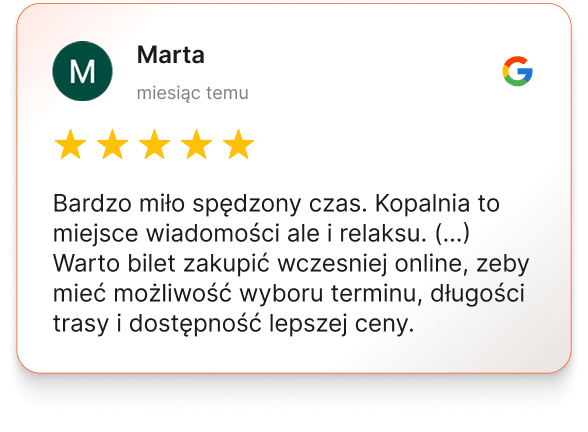
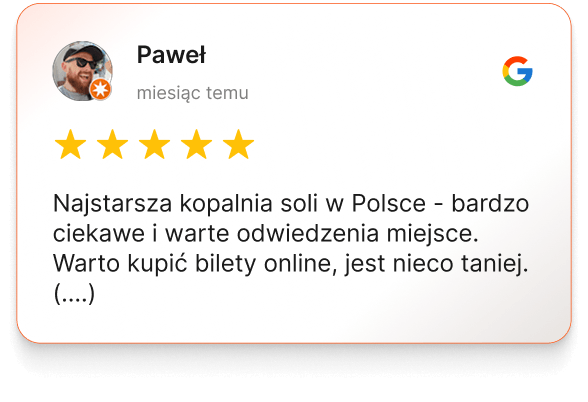
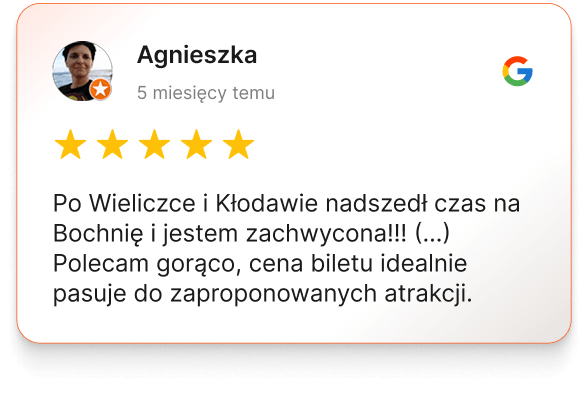
Both the Mine's excellent results and visitors' Google reviews show that tourists respond positively to dynamic pricing and the opportunity to buy at lower prices.
The ticket as an anchor: how Dynamic Pricing stabilizes attendance
Selling tickets in advance is about more than just better cash flow; it is also a safeguard against the fickle nature of human decision-making. Money spent in advance creates a strong commitment that protects a visitor's plans from a spontaneous change of mind.
The evidence from the Museum of Bochnia Salt Mine is telling: although they could change their plans, only 5% of visitors who bought a ticket online at least one day in advance actually did so:
- only 2.7% requested a refund,
- 1.7% changed the date,
- and about 1% neither requested a refund nor changed the date - they simply didn't show up despite having paid (so-called “no-shows”).
Securing the marketing investment
If even people who have already paid and formally committed their time can back out, how fragile are the plans of those who only considered visiting but didn't buy a ticket? For them, the slightest nudge is enough - a change in the weather, another idea for the weekend, or plain laziness - and the entire costly marketing effort goes to waste.
The ticket acts as a psychological anchor. When customers have already taken action (bought a ticket) and know they would have to spend time getting in touch to request a refund, their plan becomes “locked in.” As humans, we are far less susceptible to distraction when the plan is already paid for.
That's why it matters so much that, in line with the “anchoring” hypothesis described above, implementing Droplabs Dynamic Pricing significantly increased the share of visitors paying in advance. This larger pool of customers with “anchored” plans translated into stable attendance. The estimated attendance increase from this effect is 2,800 additional visitors over six months, a 7% increase over the attendance achievable with a traditional sales model. Dynamic Pricing does more than lift profits - above all, it protects attendance against shifts in customer sentiment.
Revenue growth despite greater accessibility
Dynamic pricing made it possible to tap into the potential of less price-sensitive customers who, given the choice, deliberately picked tours at higher prices. The revenue surplus generated through the online channel above the set minimum prices amounted to several hundred thousand PLN over six months.
In addition, thanks to online sales, the Mine earned tens of thousands of PLN in additional revenue from unused tickets (so-called “no-shows”). Although the Mine remains very visitor-friendly, offering flexible refunds and date changes, just under one percent of online payments stays with the Mine when guests neither show up nor request a refund or date change.
Droplabs Dynamic Pricing is the key to balancing the Mine's goals. The system makes it possible to offer lower prices to price-sensitive customers while generating satisfactory revenue for the Mine. As a result, the attraction can keep growing and continue to deliver unforgettable experiences to its visitors.
Service transformation: comfort for visitors and employees
The focus on the online channel brought a radical change in visitor service and logistics. As many as 80% of individual visitors bought their tickets online and went straight to the shaft elevator, where the guide scanned their tickets, bypassing the traditional ticket office entirely. Thanks to this large-scale shift to digital, the Mine achieved an important goal: no queues at the ticket office and much less stress for employees and visitors. Even on record days (close to a thousand visitors per day) and in the limited space of the hall, the high share of advance purchases meant there was no tension and no bottlenecks before going underground.
Reducing box-office sales to just 20% of the total means that staff (and cashiers' time) can be reassigned to other key tasks directly related to visitor service and to planning additional tours.
Marketing and brand boost: fuel for future attendance
A key driver of future attendance is the brand's online image. Over the period analyzed, the average Google rating rose from 4.6/5 to an impressive 4.9/5 (year-over-year comparison of the same periods). This achievement is primarily thanks to the Mine's management and team, who delivered higher-quality service and tours while managing pricing effectively.
High ratings are also the best confirmation that the Droplabs Dynamic Pricing system as a whole is effective and fair - otherwise, dissatisfaction would have shown up in reviews immediately. At the same time, the Mine recorded an almost sevenfold increase in the number of new reviews (1,554 versus 227 the previous year). This surge was directly supported by the Droplabs system, which automatically encourages customers to leave a review after their visit.
A flood of fresh, positive reviews is the strongest form of “social proof,” instantly building trust and motivating more potential visitors to book.
Conclusions: balancing mission and profitability
Implementing Droplabs Dynamic Pricing in the first quarter of 2025 proved to be an important factor in helping the managers of the Museum of Bochnia Salt Mine strike a balance between the social mission of making UNESCO heritage accessible and the need to generate funds for developing and maintaining the monument.
- Confirmation that the strategy is fair: The increase in the average Google rating from 4.6/5 to 4.9/5 is the strongest evidence that Dynamic Pricing is effective and fair for Polish families. The Mine's team delivers higher-quality service, and higher peak prices did not reduce satisfaction or accessibility, which is crucial for managing a public site.
- Maximizing accessibility and attendance: The new pricing system opened the Mine to families with smaller budgets, offering lower prices outside peak times while also encouraging earlier purchases.
- Operational and financial optimization: Thanks to early demand signals, the Mine could proactively create new tours and optimize resource allocation. Despite greater price accessibility, revenue from individual visitors grew by 45% year on year, driven by tapping into the potential of less price-sensitive customers and by higher overall attendance.
- Better service: The dominance of the online channel (80% of sales) eliminated queues at the ticket office, increasing comfort for guests and employees and allowing management to redeploy staff from the ticket office to key service tasks.
The Museum of Bochnia Salt Mine has shown that Droplabs Dynamic Pricing is not an untested novelty in the heritage sector. It is a proven, effective management tool that other public cultural sites and tourist attractions can successfully apply, enabling them to fulfill their cultural and social mission while generating the revenue essential for developing and maintaining such important Polish monuments.