Data for decisions and process optimization in one place: Business Intelligence combined with the sales system
This post is part of a larger article: AI in the service of heritage: Droplabs Dynamic Pricing and attendance prediction in shaping sustainable tourist behavior in Tatra National Park.
The challenge
Another important challenge TPN wants to tackle is minimizing queues for entrance tickets. Long queues lead to large crowds gathering at critical points:
- Long waits and large crowds in one place increase litter (packaging, cigarette butts), which often ends up on the ground or is blown away by the wind, despite the presence of bins.
- Large groups of people also generate more noise, which disturbs wild animals and their natural behavior.
- Although ticket points are usually paved, waiting off designated paths (especially in high season, when queues are very long) can lead to trampling and destruction of vegetation in the protected zone.
- Toilets overloaded in a short time can cause sanitary problems. All of this affects both visitors' comfort and the Park's ecological peace.
- In addition, long waits for tickets delay the start of hikes and reduce the time available on the trail, which can affect tourist safety (e.g., having to return after dark).
What's more, at a scale of millions of tourists a year, eliminating printed tickets significantly reduces paper consumption. It also reduces littering in the Park from lost or discarded tickets, further supporting the protection of the delicate Tatra ecosystem.
Serving tourists who bought their ticket online is much faster than handling transactions at a physical ticket point. TPN already accommodates such visitors by allowing online ticket holders to skip the queues at ticket points. Unfortunately, internet coverage and stability are often poor in the Park and its immediate surroundings, which makes buying tickets online on site difficult. Encouraging tourists to buy in advance is another challenge. Since entrance ticket prices at Tatra National Park are regulated by law, applying the same strategy as for parking is not the first choice at this stage.
Solution
Following the principle that you cannot effectively change what you do not measure, Tatra National Park, with the help of Droplabs, has launched a Business Intelligence (BI) system to professionally monitor ticket purchase data across all available channels.
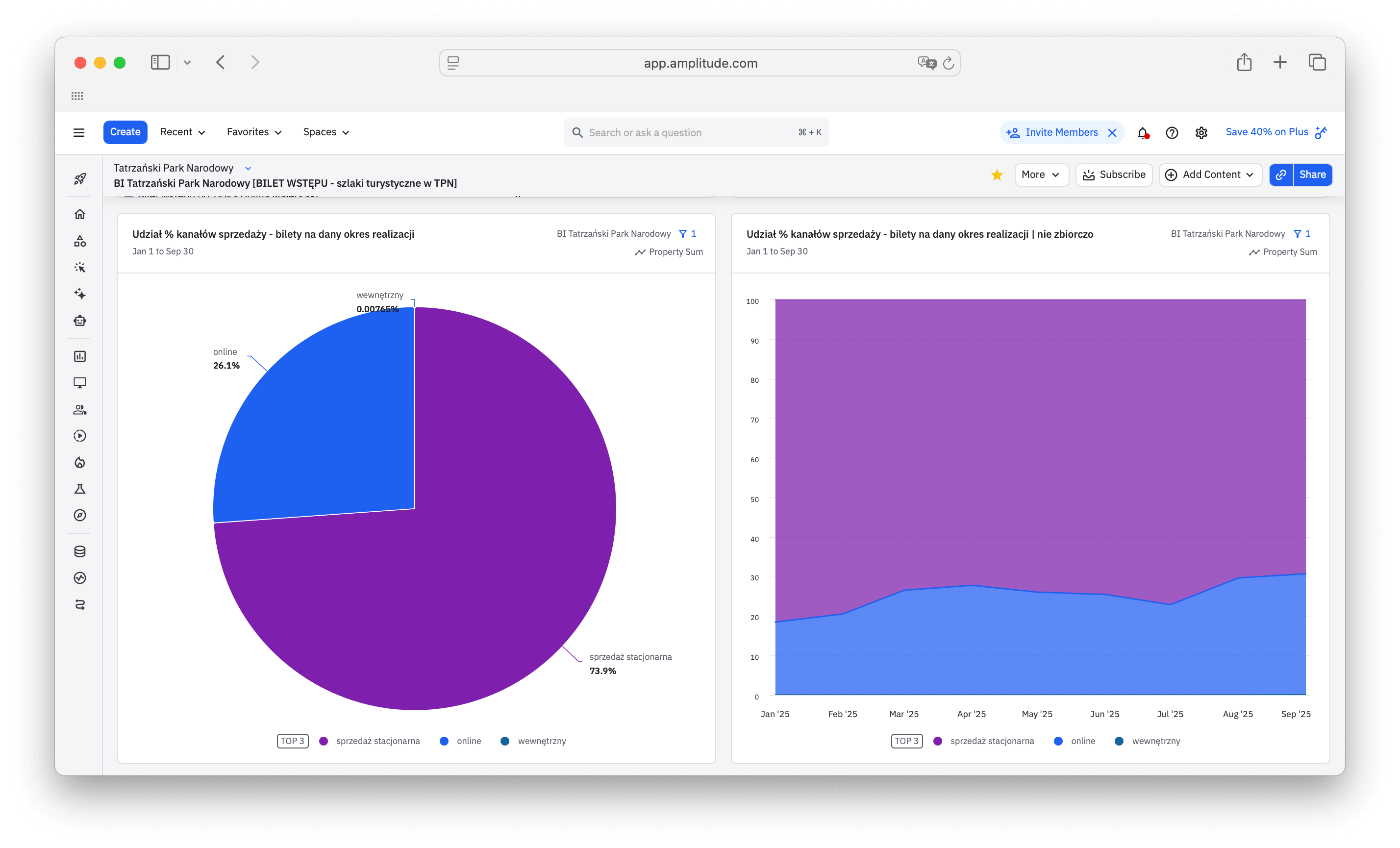
For managers, it is a single place, a convenient view in a web browser, for viewing and drawing conclusions from data: attendance, advance purchases, popular times, services, and more. In practice, it makes it possible to track how indicators such as attendance or the share of tickets bought online change over time, including against comparison periods, for example year over year.
The Business Intelligence (BI) system allows TPN to find answers to management and analytical questions in one place. To better understand what Business Intelligence means in practice, here are some example questions this system can help answer:
- Communication: Has strengthening the message in new channels led to a real increase in the share of online ticket sales?
- Logistics: Can ticket offices be staffed more efficiently, based on the times when entrance tickets are bought in different periods of the year?
- Education: Can educational messages and offers be better tailored to who visits the Park? How many groups are there, and what is the mix of reduced and standard tickets? What is the share of multi-day tickets?
- Research: How does data on the number of tourists in the Park at certain times correlate with recorded noise or pollution levels?

BI enables TPN to act on data, not just intuition. The BI system was configured by Droplabs, which is also responsible for maintaining the transfer of structured data into it, both from online channels and from ticket offices.
Growth of the online share for entrance tickets
The growing popularity of buying TPN tickets online is clear. In the first quarter of 2024, the share of tourists with an online ticket was 14%. In the following months, the trend gained momentum, reaching 22% in September 2024 and 31% in September 2025.
These statistics do not include tourists using the cable car to Kasprowy Wierch (operated by PKL) or people paying the fee for entering land owned by the Forest Community of the Eight Entitled Villages in Witów at the ticket offices of the Chochołowska Valley (Siwa Polana) and the Lejowa Valley. In these two cases, tickets are sold not by TPN but by the Forest Community of the Eight Entitled Villages.
Tatra National Park is actively looking for ways to increase the share of online purchases, which benefits both nature and visitor comfort. One example is the test launch of three Starlink internet access points. Users connect by scanning a special QR code placed at Palenica Białczańska, in the Kościeliska Valley, and at Włosienica Glade.

This post is part of a larger article: AI in the service of heritage: Droplabs Dynamic Pricing and attendance prediction in shaping sustainable tourist behavior in Tatra National Park.